How Many People Are in This Family? A Simple Riddle That Challenges Careful Thinking
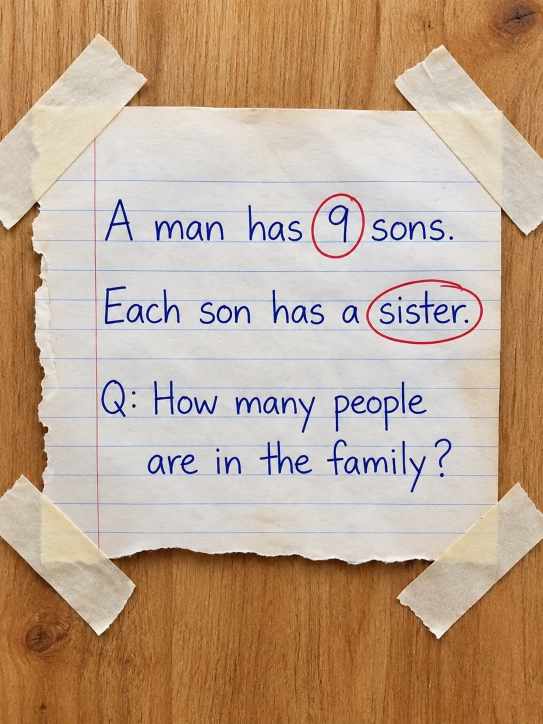
Certain approaches lead to an early total of nineteen people. Adding nine sons, nine sisters, and one father produces that number. However, the wording of the riddle contains the source of this common mistake.
The riddle states that a man has nine sons and that each son has a sister. It does not specify that each son has a different sister.
All nine sons may share one sister. That possibility holds the key to solving the puzzle.
A Careful Breakdown of the Family
Nine sons form the first group.
One sister is shared by all nine sons.
One father is the parent of the children.
The total becomes nine plus one plus one. The sum equals eleven people.
The solution emerges through close attention to the words provided in the riddle.
Many people reach an incorrect total because of the way the sentence is constructed. The phrase “each son has a sister” can lead the mind to imagine several distinct sisters. The assumption that each son has a different sister often arises automatically.
This riddle illustrates the value of careful attention to language. It tests reading comprehension, logical reasoning, and the ability to resist making assumptions before examining the available information.
The experience also highlights a broader lesson that applies to everyday situations: things that appear obvious at first glance may deserve a closer look.
Step-by-Step: How to Find the Correct Answer
A simple, step-by-step approach leads to the correct total.
Begin by counting the sons. There are nine.
Next, count the sister. There is one sister shared by all nine brothers.
Finally, add the father. There is one father mentioned in the description.
The combined total of family members is eleven.
The process becomes clear and straightforward once the wording receives proper attention.
A useful habit for solving similar puzzles is to slow down before answering. Examine every word carefully, especially when a sentence leaves room for more than one interpretation. The detail that makes a riddle challenging often lies in its precise wording.
Did the answer come to mind immediately, or did you initially count nine separate sisters before reading the sentence again?
Why Do So Many People Get the Answer Wrong?
Riddles of this type are entertaining because they encourage people to question their first impressions. They also promote patience, attention to detail, and the satisfaction that comes from discovering a simpler explanation.
The final answer is eleven people: the father, his nine sons, and their one sister.
No additional siblings are mentioned. The wording itself contains all the information needed to solve the puzzle.
The riddle is also an easy way to start a conversation with friends or family members. Their responses may reveal how many people arrive at the common initial calculation before reconsidering the sentence.
The Importance of Reading the Question Carefully
When people first encounter the riddle, the mind quickly forms a picture of the family. The nine sons are easy to identify, and the reference to a sister follows. The word “each” can then encourage the assumption that every son has a different sister.
A slower second reading reveals another possibility: all nine brothers can share the same sister. The father remains the single parent mentioned in the riddle, and the total settles at eleven.
Language plays an important role in puzzles like this. One shared sister satisfies the condition that each son has a sister without requiring nine separate sisters.
Everyday conversations contain similar examples. Statements that appear to describe multiple items may actually refer to something shared. Careful listening and reading can help reveal the intended meaning.
A Simple Puzzle With a Lasting Lesson
The popularity of this riddle comes from its ability to make people pause over a short sentence. The initial total of nineteen may seem reasonable, but reconsidering the wording reveals why it is unnecessary to count nine separate sisters.
The father forms the starting point of the family description. The nine sons form the next group, and their shared sister completes the list of children. The total remains eleven.
The lesson extends beyond arithmetic. Taking a moment to verify an answer can prevent mistakes. Resisting the first calculation can encourage better reasoning, while paying attention to details can lead to a clearer understanding of a situation.
Similar challenges appear in many other types of puzzles. Carefully arranged words can create multiple interpretations, but the best solution stays as close as possible to the information actually provided.
Can You Challenge Your Friends With This Riddle?
Try presenting the riddle to friends or family members without revealing the answer immediately. Ask them to read the question carefully and calculate the total number of people in the family.
Some may arrive at eleven straight away. Others may initially count nine sisters and reach nineteen before reconsidering the wording.
The moment of realization comes when they recognize that one sister can be shared by all nine brothers. Once that possibility becomes clear, the answer is easy to verify.
The riddle remains engaging because its wording encourages a common assumption. Careful reading corrects that assumption and leads to the accurate result.
The Final Answer
The family consists of one father, nine sons, and one sister. Adding these groups together gives a total of eleven people.
Nine sons + one sister + one father = eleven people.
The key is recognizing that the nine sons can share the same sister. The description does not require nine different sisters, so counting them separately introduces people who were never mentioned.
This small puzzle offers a useful reminder to pause, examine the details, and avoid jumping to conclusions. Sometimes, the difference between a wrong answer and the right one comes down to a single word.
Share the riddle with someone and see how they respond. Will they recognize the shared sister immediately, or will they arrive at the higher total first?